


Disease Progression of Primary Biliary Cholangitis (PBC)
Insight into the Pathogenesis of PBC
PBC occurs when immune dysregulation results in the destruction of cholangiocytes in small and medium bile ducts. This leads to progressive cholestasis due to the number of bile ducts decreasing, driving the development and progression of fibrosis and cirrhosis.1,2
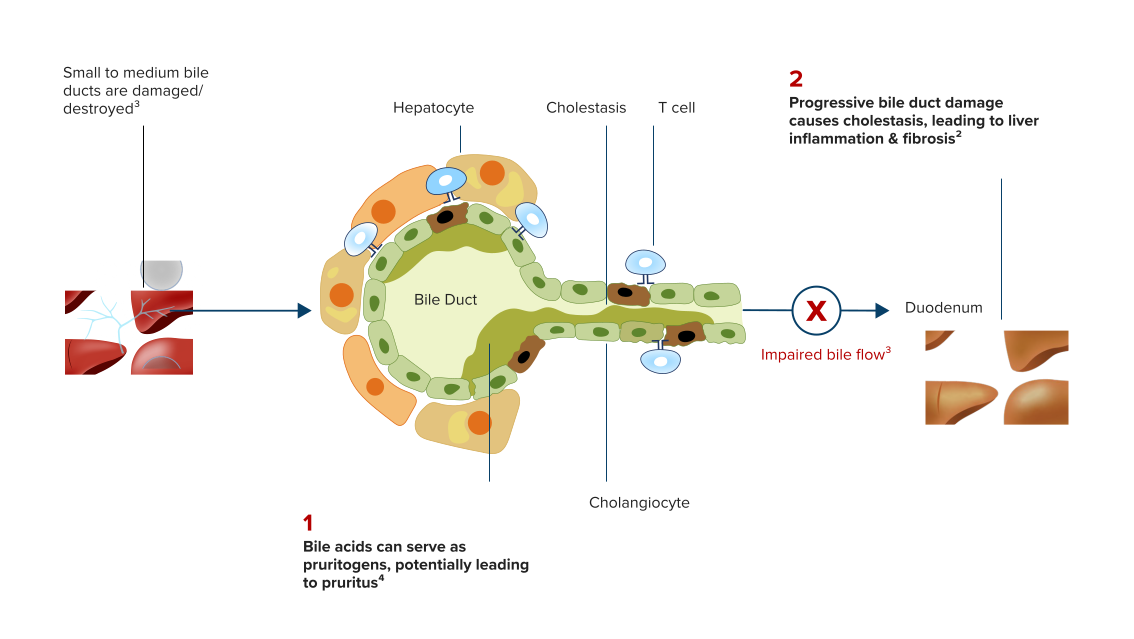
PBC is a progressive disease, with up to 50% of untreated patients developing cirrhosis within 4 years, underscoring the need for early diagnosis and treatment.5,6
PBC is characterized by an immune-mediated attack on intrahepatic bile ducts that results in the gradual destruction and eventual disappearance of the bile ducts.1,2
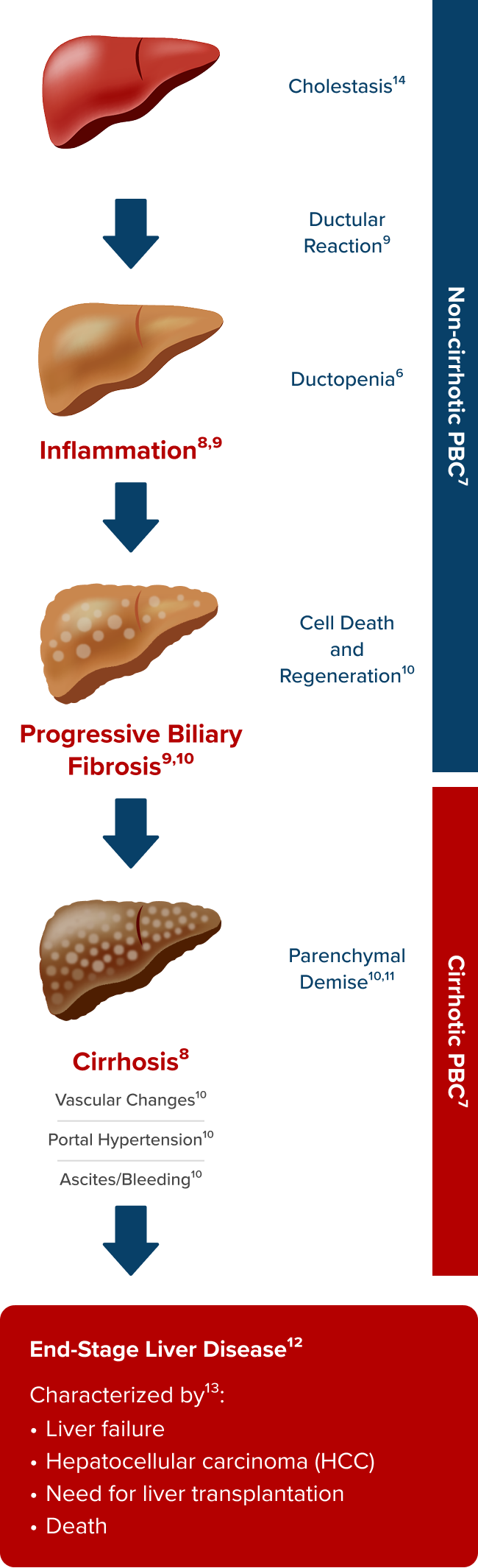
PBC Disease Progression
PBC Disease Progression Stage Summary
Cholestasis14
Impaired bile flow leads to the retention of bile acids and other potentially toxic constituents of bile, promoting hepatocellular damage.
Ductular Reaction9
The appearance of immature cholangiocytes. Extensive ductular reaction is associated with an inadequate response to 1L (1st line) treatment. Ductular reaction can trigger myofibroblast activation and influence inflammatory cell recruitment, thus perpetuating a fibrosis progression.
Ductopenia6
Progressive bile duct damage leads to ductopenia, inflammation, and collagen disposition. Ductopenia does NOT ONLY occur in patients with advanced stage, but also early-stage disease without significant fibrosis.
Cell Death & Regeneration10
Chronic inflammation and repeated injury to bile ducts triggers the proliferation of bile ductular cells and fibrosis caused by adjacent myofibroblast cells in the hepatic mesenchyme.
Parenchymal Demise10,11
Fibro-proliferative bile duct cells extend into the hepatic parenchyma, bridging adjacent portal areas and leading to biliary cirrhosis without renewal of bile ducts. Portal hypertension11 usually occurs after a patient develops cirrhosis, leading to ascites/bleeding7,11 and enlarged veins11.
Key Markers in PBC Progression
ALP and total bilirubin levels are indicators of long-term clinical outcomes.6
ALP
Serum ALP elevation can have different sources (eg, liver, intestine, bone, placenta). The hepatic origin of elevated serum ALP is usually supported by simultaneous elevation of serum GGT and/or conjugated bilirubin. Please note that abnormal serum ALP is associated with ductopenia and disease progression.6

ALP Healthy Range:
30 IU/L–120 IU/L15

Elevated alkaline phosphatase6
- Cholestasis biochemical marker associated with ongoing bile duct destruction and disease progression

Lower alkaline phosphatase16
- Associated with longer liver transplant‑free survival
Bilirubin
Hyperbilirubinemia occurs as PBC progresses, and significant elevations are typical of advanced disease, signaling the development of cirrhosis alongside falling platelet count, reduced albumin concentrations, and elevated international normalized ratio. Elevations in bilirubin are considered a predictor of poor outcomes in PBC.6
Bilirubin Healthy Range:
Total bilirubin 0.1 mg/dL–1.2 mg/dL17
Elevated bilirubin6,18
- Indicator of cholestasis, cirrhosis, and poor hepatic function
Lower bilirubin16
- Associated with longer liver transplant–free survival
Long-Term Outcomes in PBC19
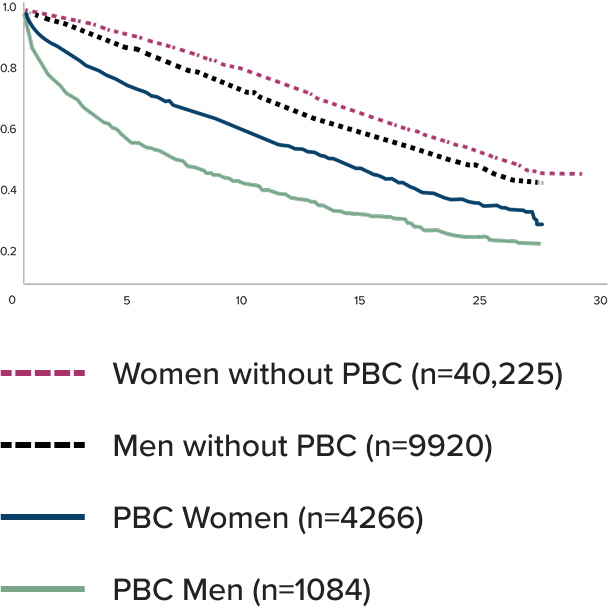
In a Swedish observational study, patients with PBC (N=5350) were compared to reference patients from the general population.
Survival Rates for Men and Women With and Without PBCa,b,c
Rates of Liver Eventsd for Men and Women With and Without PBCa,b,c
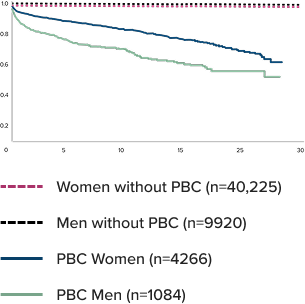

Compared to the general population, patients with PBC had lower survival and higher liver complication rates. Outcomes were also found to be worse in men with PBC compared to women with PBC.19
ALP, alkaline phosphatase; GGT, gamma-glutamyl transferase.
aCompared to reference patients, patients with PBC aged 15–39 years at diagnosis had a substantially higher risk of death than those diagnosed between 40–59 and >60 years of age.19
bThe data track survival immediately following diagnosis.19
cBaseline mean age is 62.54 years and 61.67 years for the PBC and control groups, respectively. The control group was matched demographically.19
dLiver events were defined as esophageal varices, gastric varices, or ascites, including treatment interventions, and liver failure.19
References:
- Schnabl B. PPAR agonists in primary biliary cholangitis. N Engl J Med. 2024;390(9):855-858. doi:10.1056/NEJMe2313802
- Onofrio FQ, Hirschfield GM, Gulamhusein AF. A practical review of primary biliary cholangitis for the gastroenterologist. Gastroenterol Hepatol (NY). 2019;15(3):145-154.
- Leung KK, Deeb M, Hirschfield GM. Review article: pathophysiology and management of primary biliary cholangitis. Aliment Pharmacol Ther. 2020;52(7):1150-1164. doi:10.1111/apt.16023
- Düll MM, Kremer AE. Evaluation and management of pruritus in primary biliary cholangitis. Clin Liver Dis. 2022;26(4):727-745. doi:10.1016/j.cld.2022.06.009
- Trivella J, John BV, Levy C. Primary biliary cholangitis: Epidemiology, prognosis, and treatment. Hepatol Commun. 2023;7(6):e0179. doi:10.1097/HC9.0000000000000179
- European Association for the Study of the Liver. EASL Clinical Practice Guidelines: The diagnosis and management of patients with primary biliary cholangitis. J Hepatol. 2017;67(1):145-172. doi:10.1016/j.jhep.2017.03.022
- Purohit T, Cappell MS. Primary biliary cirrhosis: pathophysiology, clinical presentation and therapy. World J Hepatol. 2015;7(7):926-941. doi:10.4254/wjh.v7.i7.926
- Murillo Perez CF, Harms MH, Lindor KD, et al. GLOBAL PBC Study Group. Goals of treatment for improved survival in primary biliary cholangitis: treatment target should be bilirubin within the normal range and normalization of alkaline phosphatase. Am J Gastroenterol. 2020;115(7):1066-1074. doi:10.14309/ajg.0000000000000557
- Overi D, Carpino G, Cristoferi L, et al. Role of ductular reaction and ductular-canalicular junctions in identifying severe primary biliary cholangitis. JHEP Rep. 2022;4(11):100556. doi:10.1016/j.jhepr.2022.100556
- Kumagi T, Heathcote EJ. Primary biliary cirrhosis. Orphanet J Rare Dis. 2008;3:1. doi:10.1186/1750-1172-3-1
- National Organization for Rare Disorders. Primary biliary cholangitis. Updated April 6, 2020. Accessed December 2, 2025. https://rarediseases.org/rare-diseases/primary-biliary-cholangitis/
- Hirschfield GM. Primary biliary cholangitis: clinical insights into diagnosis and staging. Gastroenterol Hepatol (NY). 2021;17(5 suppl 5):2-5.
- University of California San Francisco. End-stage liver disease. Accessed December 2, 2025. https://surgery.ucsf.edu/condition/end-stage-liver-disease-esld
- Hohenester S, Oude-Elferink RP, Beuers U. Primary biliary cirrhosis. Semin Immunopathol. 2009;31(3):283-307. doi:10.1007/s00281-009-0164-5
- Kalas MA, Chavez L, Leon M, Taweesedt PT, Surani S. Abnormal liver enzymes: A review for clinicians. World J Hepatol. 2021;13(11):1688-1698. doi:10.4254/wjh.v13.i11.1688
- Lammers WJ, van Buuren HR, Hirschfield GM, et al. Global PBC Study Group. Levels of alkaline phosphatase and bilirubin are surrogate end points of outcomes of patients with primary biliary cirrhosis: an international follow-up study. Gastroenterology. 2014;147(6):1338-49.e5; quiz e15. doi:10.1053/j.gastro.2014.08.029
- MedlinePlus. Bilirubin blood test. Updated February 13, 2025. Accessed December 2, 2025. https://medlineplus.gov/ency/article/003479.htm
- The PBC Network. Primary biliary cholangitis (PBC) living with your diagnosis. Accessed December 2, 2025. https://liver.ca/wp-content/uploads/2018/08/EASL_PBC_Patient-Guidelines_ENG.pdf
- Marschall HU, Henriksson I, Lindberg S, et al. Incidence, prevalence, and outcome of primary biliary cholangitis in a nationwide Swedish population-based cohort. Sci Rep. 2019;9(1):11525. doi:10.1038/s41598-019-47890-2